



SAVT products are enabling better displays.
Discover how SAVT™ technology has reimagined video transport, with clear benefits for set makers, panel makers, and OEMs.
So, what is SAVT technology, and what can it do?
SAVT technology is a smarter approach to video transport, transmitting uncompressed video in analog form. The result is better color, higher-resolution displays, and cleaner industrial design.

A smarter approach
Today’s panels convert digital signals to high-voltage analog. SAVT extends that analog path further back, using higher quality converters.

Better color
Each SAVT electrical pulse delivers 14 bits of resolution. That’s enough for 12-bit color with headroom for panel corrections like gamma.

Higher resolutions
SAVT technology provides a 10x bandwidth advantage over legacy digital video, making larger 4K240 and 4K480 panels practical.

Cleaner design
A lower clock rate creates less RFI and enables longer cable distances. Design is simplified and system costs reduced.
PRODUCT LINEUP
Unlock the advantages of SAVT technology.
SAVT products transport high-quality, low-latency video signals in-display, with negligible EMI emissions, delivering differentiation for OEMs, cost savings for set makers, and bleeding-edge capabilities for panel makers.
HY1003
SAVT Display Driver IC
The HY1003 is a pure 14-bit, 4K200 source driver for LCD-based televisions, providing optimized digital-to-analog conversion..
HY2001
SAVT TCON
The HY2001 is a pure 14-bit, 4K240 TCON for LCD-based televisions, translating SAVT video signals into precise timing commands to control every pixel’s activation.
HY2501
SAVT IP Core
The HY2501 is an IP library license specifically designed to enable seamless integration of the HYPHY transmitter into System on Chips.
BY THE NUMBERS
0x
More efficient than a legacy digital video link
0Hz
Next-gen panel support without added pins
0-bit
Full 14-bit end-to-end color processing
0MHz
Super-low clock rate eliminates interference
BUTTERFLY CHIPSET SOLUTION
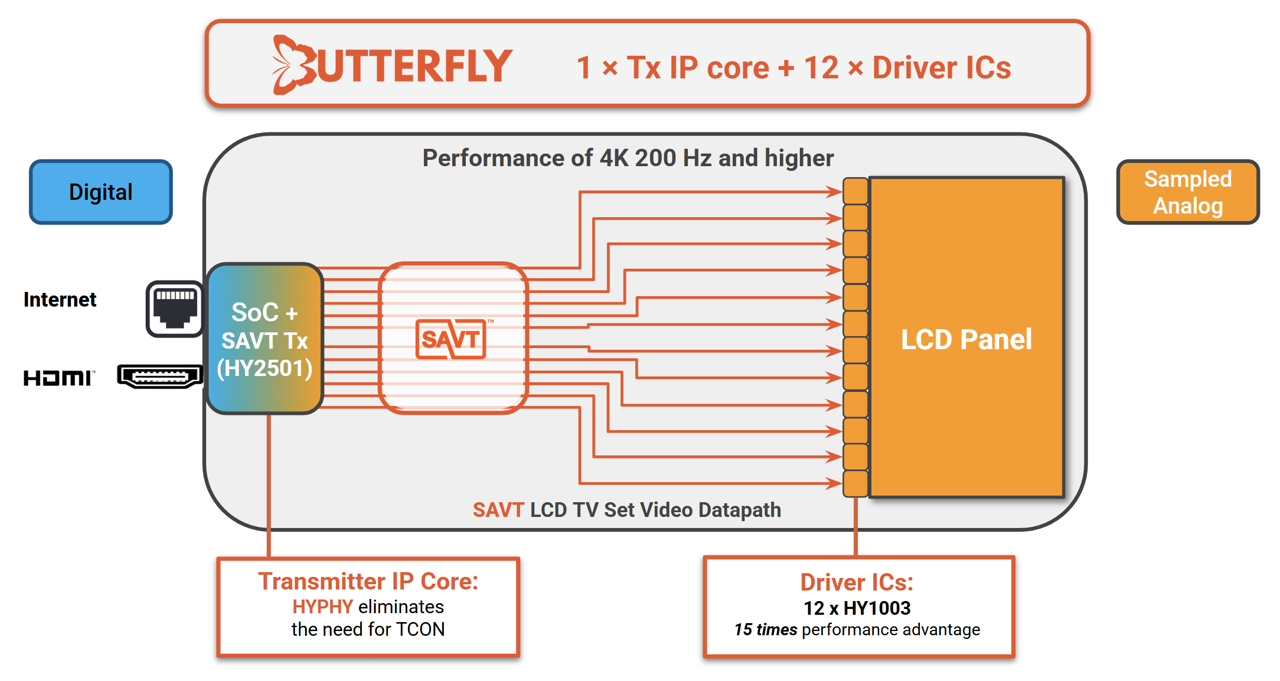
The Butterfly Chipset is the complete SAVT technology solution.
Butterfly is a complete premium display driver solution, efficiently transporting high-quality video signals inside the display. It consists of a Timing Controller (TCON) chip with an embedded SAVT transmitter, coupled with our SAVT technology-based Display Driver IC (DDIC) chips.
SAVT offers real advantages.
SAVT technology transforms large panel display performance. Video processing clock rates are reduced by 15x, enabling faster, larger panels that display deeper colors. Production is simplified, and costs reduced.

See SAVT technology in action.
Schedule a live demo to discover how SAVT can unlock the full potential of your displays.

FAQs
Got questions about SAVT technology? Find answers here, and get in touch if you’d like to know more.
Video is analog at both ends – when a CMOS sensor captures video, and when a display panel renders it. We add a digital encoding layer in between for transport. But that layer costs bandwidth, power, and ultimately, picture quality. SAVT transmits uncompressed video in analog form, with the equivalent of 14 bits of precision.
No – but it’s a good question. Inside a current panel, digital video runs to driver ICs bonded to the panel's edge. Those chips convert the digital signal back to analog, amplify it, and send a high-voltage analog signal to each sub-pixel — which is what actually twists the liquid crystal or excites the OLED material. The final signal is already analog. Digital is just a transit format. SAVT extends that analog path further back into the panel, into higher-quality digital-to-analog converters with 14-bit precision. It replaces the primitive 8-bit “ladder DAC” pairs used in today’s driver ICs — and runs at a much lower clock rate while doing it.
Two of the obstacles are immediate. To double the link speed, designers can either double the number of cables — clearly more expensive — or double the clock speed. A faster clock is harder to route through internal cabling, and electromagnetic interference gets worse. The deeper obstacle is semiconductor economics. Pushing digital link speeds higher means moving driver ICs to advanced process nodes which are far more expensive. Worse, those advanced CMOS processes can’t perform the driver IC’s other essential job: amplifying the analog signal to six volts or more for delivery to each sub-pixel. SAVT sidesteps the problem entirely. Because it runs at one-tenth the clock speed, it can be built in inexpensive, legacy 150 nm processes — and its performance can scale 4x or more without changing process nodes. That’s why SAVT is the logical foundation for the next generation of panel designs.
Excellent question. The answer is: no! We’ve tested and proven that noise is not an issue with SAVT, and we’ll be publishing more about that soon.