
SAVT technology is the future of display.
SAVT efficiently transports pure uncompressed baseband video, increasing display performance and lowering costs and complexity.

So, what is SAVT technology, and what can it do?
SAVT technology is a smarter approach to video transport, transmitting uncompressed video in analog form. The result is better color, higher-resolution displays, and cleaner industrial design.

A smarter approach
Today’s panels convert digital signals to high-voltage analog. SAVT extends that analog path further back, using higher quality converters.

Better color
Each SAVT electrical pulse delivers 14 bits of resolution. That’s enough for 12-bit color with headroom for panel corrections like gamma.

Higher resolutions
SAVT technology provides a 10x bandwidth advantage over legacy digital video, making larger 4K240 and 4K480 panels practical.

Cleaner design
A lower clock rate creates less RFI and enables longer cable distances. Design is simplified and system costs reduced.
HOW DOES IT WORK?
SAVT technology vs legacy digital video
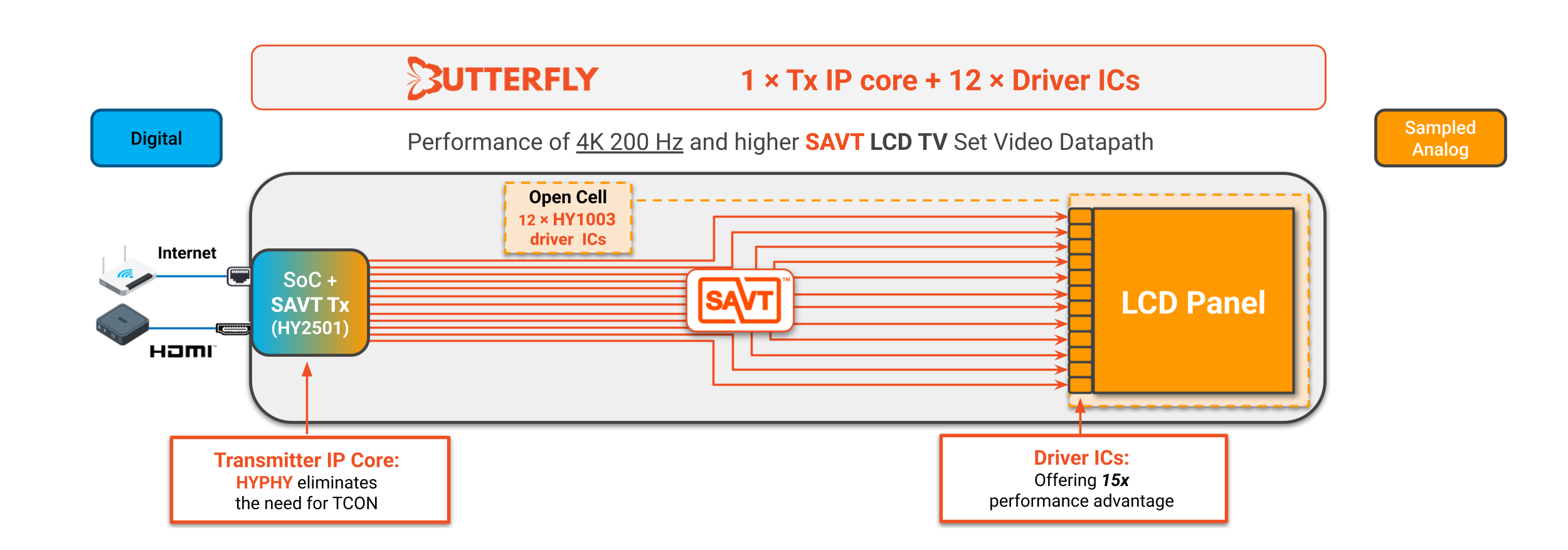
When a CMOS sensor captures video, or when a display panel renders it, the signal is analog — not digital. A digital encoding layer is added in between for transport. But that layer is expensive: it costs bandwidth, power and, ultimately, picture quality. SAVT’s smarter approach delivers a 15x or better improvement over today’s digital video links.
Standard encoding
Today’s standard, 8b/10b encoding, transmits each byte of video using ten electrical pulses. Each pulse is interpreted as a 0 or a 1, then reassembled into bits and bytes. To send a single red, green, or blue sub-pixel, you need ten symbols on the wire.
The SAVT solution
SAVT transmits uncompressed video in analog form. Each sub-pixel travels as a single electrical pulse — one symbol, not ten. The SAVT receiver doesn’t read the pulse as a 0 or 1; it reads it as a voltage value. The higher the voltage, the darker the color. HYPHY’s receiver resolves that voltage with the equivalent of 14 bits of precision.
Better results
Inside current panels, driver ICs convert the digital signal back to analog, amplify it, and send a high voltage analog signal to each sub-pixel. SAVT extends that analog path further back into the panel, into higher quality converters. It replaces the primitive 8-bit ‘ladder DAC’ pairs used in today’s driver ICs, and runs at a much lower clock rate while doing it.
Standard encoding
Today’s standard, 8b/10b encoding, transmits each byte of video using ten electrical pulses. Each pulse is interpreted as a 0 or a 1, then reassembled into bits and bytes. To send a single red, green, or blue sub-pixel, you need ten symbols on the wire.
The SAVT solution
SAVT transmits uncompressed video in analog form. Each sub-pixel travels as a single electrical pulse — one symbol, not ten. The SAVT receiver doesn’t read the pulse as a 0 or 1; it reads it as a voltage value. The higher the voltage, the darker the color. HYPHY’s receiver resolves that voltage with the equivalent of 14 bits of precision.
Better results
Inside current panels, driver ICs convert the digital signal back to analog, amplify it, and send a high voltage analog signal to each sub-pixel. SAVT extends that analog path further back into the panel, into higher quality converters. It replaces the primitive 8-bit ‘ladder DAC’ pairs used in today’s driver ICs, and runs at a much lower clock rate while doing it.

Unlocking the power of SAVT.
SAVT enables better displays across sectors, including high-res visuals for premium TVs, greater refresh rates and resolutions for computer monitors and 3D screens, and long-distance cabling for digital signage.
Premium TV
SAVT’s uncompressed analog video transport unlocks higher frame rates and deeper colors for premium TVs. It allows manufacturers to produce larger, more power-efficient televisions at a lower cost.
Gaming Monitor
SAVT technology enables double and quadruple refresh rates, such as 4K 240Hz and 4K 480Hz with 12-bit color and ultra-low latency, ideal for smoother on-screen motion and lowered input lag.

Naked-Eye 3D Screen
These screens require 2x to 4x standard resolution, along with a very high refresh rate to prevent flicker. SAVT technology meets these performance needs, and reduces internal display panel wiring.

Digital Signage
Long cable distance support and high bandwidth capabilities make SAVT technology ideal for the next generation of digital signs.

Notebook & Laptop
Utilizing SAVT technology eliminates the need for expensive shielded coaxial cable that has to route over the laptop hinge.

Breaking the TV Bandwidth Barrier: How SAVT Enables 4k 200Hz and Beyond
Discover how HYPHY’s SAVT technology delivers up to 10x greater efficiency, eliminates bandwidth constraints, and enables 4K 200Hz and beyond, making next-generation TVs easier to manufacture.
Play full video
Breaking the TV Bandwidth Barrier: How SAVT Enables 4k 200Hz and Beyond
Discover how HYPHY’s SAVT technology delivers up to 10x greater efficiency, eliminates bandwidth constraints, and enables 4K 200Hz and beyond, making next-generation TVs easier to manufacture.
Play full videoSee SAVT technology in action.
Schedule a live demo to discover how SAVT can unlock the full potential of your displays.